
1. Executive Summary
This report analyzes the evolution of the Security Orchestration, Automation, and Response (SOAR) market, focusing on:
- Automation adoption trends
- SOC operational challenges
- Vendor architectures and integration models
The analysis is based on:
- Industry research (Forrester, analyst reports, market data)
- Vendor capabilities and ecosystem positioning
- Observed enterprise security operations trends
Key Finding
While SOAR adoption continues to grow, a critical gap remains:
- Automation capability is not consistently translating into operational efficiency.
Research indicates that:
- Many organizations struggle to operationalize SOAR at scale
- Automation often remains limited to repetitive, low-level tasks
- Integration and maintenance overhead reduce effectiveness
SOAR capabilities are therefore evolving toward: Embedded and platform-based automation models, rather than standalone orchestration tools.
2. Market Overview & Key Trends
2.1 Market Reality
The SOAR market continues to grow steadily:
- Estimated at ~$1.8B–$2B in 2025, projected to exceed $4B–$5B by 2030+
- Growth driven by:
- Increasing cyber threats
- Alert volume explosion
- SOC staffing constraints
At the same time, SOC teams face operational pressure:
- Analysts must handle large volumes of alerts, many of which are never fully investigated
- A significant portion of security work remains manual and repetitive
Key Insight
The limitation is not automation capability, it is the ability to scale, maintain, and operationalize it effectively.
2.2 Key Market Trends
Trend 1: SOAR Is Becoming an Embedded Capability
- The standalone “SOAR” category is gradually fading
- Its capabilities are being integrated into broader platforms (SIEM/XDR)
This reflects a shift toward unified security operations platforms
Trend 2: Playbook Centric Automation Is Reaching Its Limits
Research highlights structural challenges:
- Organizations manage hundreds of playbooks, increasing complexity
- Maintenance effort grows continuously over time
- Static playbooks struggle with dynamic threats and real-world variability
Result:
- Automation becomes difficult to maintain
- ROI decreases as operational overhead increases
Trend 3: Integration Complexity Is a Core Constraint
Traditional SOAR relies heavily on integrations:
- Multiple APIs across security tools
- Continuous connector updates and troubleshooting
Challenges include:
- Integration failures breaking automation workflows
- Partial automation instead of end-to-end orchestration [linkedin.com]
Outcome:
- Increased operational friction
- Reduced reliability of automation
Trend 4: Complexity Limits Adoption and Value
- High implementation and maintenance effort
- Dependency on specialized engineers
In fact:
Trend 5: Convergence with AI and Platform-Based Security
Market direction shows:
- AI assisted investigation and automation
- Hyper automation replacing static workflows
- Integration with SIEM, XDR, and exposure management
SOAR is evolving into:
A capability within integrated SOC platforms not a standalone layer
3. Key Operational Challenges in SOAR Adoption
1. Playbook Maintenance Overhead
- Continuous updates required
- Increasing engineering dependency
2. Limited Automation Scope
- Strong for repetitive tasks
- Weak for complex decision-making workflows
3. Integration Dependency
- Automation depends on external tools
- Gaps reduce effectiveness
4. Process Maturity Gap
- SOAR amplifies existing processes
- Poor processes lead to poor automation outcomes
Key Insight
Many SOAR deployments fall short not because of technology limitations, but because of architectural and operational misalignment.
4. Architectural Shift: From Orchestration to Platform Automation
Two Models Emerging
Tool-Centric SOAR
- Standalone orchestration layer
- Integration heavy
- High maintenance
Platform Centric Automation
- Embedded within ecosystem
- Native integrations
- Unified workflows
Operational Comparison
| Dimension | Tool Based SOAR | Platform Based Automation |
| Integration Effort | High | Lower |
| Maintenance | High | Reduced |
| Automation Reliability | Moderate | Higher |
| Analyst Efficiency | Lower | Higher |
5. SOC Maturity Model
Model Overview
This model defines five levels of SOC maturity, based on:
- Automation adoption
- Operational efficiency
- Integration depth
- Architectural approach
It reflects real-world industry findings:
- SOCs are overwhelmed by alert volume and manual processes
- SOAR helps but is often limited by complexity and maintenance
- Integrated platforms increasingly outperform fragmented toolsets
The 5-Level SOC Maturity Model
Tier 1 — Reactive SOC (Manual Operations)
Characteristics:
- No automation
- Heavy reliance on manual triage
- Alerts handled individually
- Disconnected tools
Challenges:
- Extreme alert fatigue
- Long response times
- High analyst workload
Industry context:
SOC teams can receive thousands of alerts daily, with many not investigated
Automation Level:
None
Operating Model:
Tool-based, fragmented
Tier 2 — Assisted SOC (Basic Automation)
Characteristics:
- Initial SOAR adoption
- Basic playbooks (phishing, enrichment)
- Partial integration between tools
Challenges:
- Automation is limited to repetitive tasks
- Still dependent on manual workflows
Insight:
SOAR is effective at automating “doing” tasks, but not complex decision-making
Automation Level:
Low (task level automation)
Operating Model:
Tool-based with add-on automation
Tier 3 — Orchestrated SOC (Playbook Driven Automation)
Characteristics:
- Extensive use of SOAR
- Playbooks across multiple use cases
- Integration across SIEM, EDR, TI, ticketing
Challenges:
- Playbook sprawl
- High maintenance overhead
- Integration instability
Insight:
Organizations may manage hundreds of playbooks, creating scaling issues
Automation Level:
Moderate (workflow automation)
Operating Model:
Integration-heavy architecture
Tier 4 — Integrated SOC (Platform Based Operations)
Characteristics:
- Automation embedded within platform (SIEM/XDR/SOAR convergence)
- Native integrations across security domains
- Unified workflows
Benefits:
- Reduced integration complexity
- More reliable automation
- Faster incident response
Insight:
SOAR capabilities are increasingly being embedded into broader platforms rather than used standalone
Automation Level:
High (end-to-end workflows)
Operating Model:
Platform centric
Tier 5 — Adaptive SOC (Autonomous / AI-Driven)
Characteristics:
- AI assisted automation and investigation
- Dynamic workflows (not static playbooks)
- Continuous optimization
- Context-aware response
Benefits:
- Minimal manual intervention
- High efficiency
- Scalable operations
Insight:
Next gen approaches focus on adaptive automation and AI driven workflows, replacing rigid playbooks
Automation Level:
Very High (adaptive / intelligent automation)
Operating Model:
Autonomous, platform driven SOC
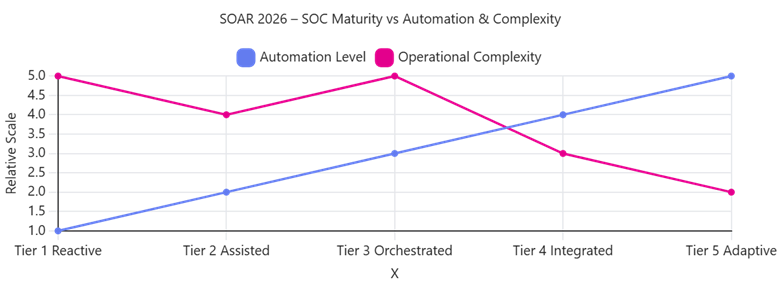
Operational complexity increases as SOAR scales through playbook driven architectures, before decreasing with platform based and integrated automation models.
Summary Table (Executive View)
| Tier | SOC Type | Automation Level | Architecture | Key Limitation |
| Tier 1 | Reactive | None | Fragmented tools | Manual overload |
| Tier 2 | Assisted | Low | Tool + SOAR | Limited impact |
| Tier 3 | Orchestrated | Moderate | Integration heavy | Maintenance complexity |
| Tier 4 | Integrated | High | Platform-based | Requires transformation |
| Tier 5 | Adaptive | Very High | AI driven platform | Emerging model |
Key Strategic Insight
Across this model, a clear pattern emerges:
The biggest shift is not from “no automation → automation”
It is from:
- Fragmented tools + orchestrated automation
to - Integrated platforms + embedded automation
Strategic Takeaway
- Tier 1–3 SOCs struggle with:
- Complexity
- Integration
- Maintenance
- Tier 4–5 SOCs succeed by:
- Reducing tool sprawl
- Embedding automation
- Enabling unified workflows
6. Competitive Landscape (Abbreviated)
| Vendor | Positioning Insight |
| Cortex XSOAR | Strong automation engine; higher complexity at scale |
| Splunk SOAR | Integrated with Splunk ecosystem; operational overhead |
| Microsoft Sentinel | Embedded automation within Microsoft ecosystem |
| IBM SOAR | Mature case management; slower innovation |
| Fortinet FortiSOAR | Platform aligned approach with strong ecosystem integration |
7. Analytical Conclusion
The SOAR market is undergoing a structural transition:
From:
- Standalone automation platforms
- Playbook-centric workflows
To:
- Integrated, platform-based security operations
Final Insight
The most effective solutions are those that:
- Reduce integration dependencies
- Minimize operational complexity
- Enable end-to-end workflows
Platforms combining automation, integration, and visibility are increasingly aligned with modern SOC requirements.